"I want to describe myself
like a painting that I studied
closely for a long, long time,
like a word I finally understood,
like the pitcher of water I use everyday..."
- Rainer Maria Rilke (read the whole poem here)
Most of the time I'm a morning person. I wake to music, take a hot shower, and try to remember to thank each part of me as I wash it, paying special attention to whatever part is particularly achy that morning. If I waitstaffed at a catering gig the night before, for example, it'll be my feet: "Thank you feet, oh good little feet. You carry me so far. What humble, useful feet I have."
Back in my room I light an incense, make my bed, open the curtains, practice yoga asanas, and meditate, but not necessarily in that order. Each day necessitates its own rhythm. Tuning in, I re-introduce myself to the guests lodging in my consciousness, and relax into the mode of a most solicitous hostess: "Anxiety, why are you wearing coat hangers for earrings, running over the neighbor's cat with the lawn mower? Come have a seat here and tell me about it. Or keep running amuck like that, that's fine too, but know the offer still stands. I'm just going to pay attention and breathe."
In the kitchen, I make oatmeal and turn on the faucet for the cat to drink from. I sit at the table with my breakfast and write somewhere around three pages, letting whatever's on my mind spill into my journal with as little filter as possible. Among other topics of interest (joys, dreams from the night before, hopes, interactions, epiphanies), I write about those nuissances, my fears. A wise friend of mine once said that naming your fears declaws them.
Things I'm afraid of, as far as I've noticed: being misunderstood, being confined by an idea, being more of a burden than a help, not writing anything that people will want to read, and a whole array of issues having to do with money and the lack thereof.
Phew! Now you know. It's a relief, like shining a flashlight into a dark corner where you thought something really horrible was lurking, and it turns out to be an overweight poodle, just sitting there with its tongue hanging out, crapping all over your hopes and dreams. Which is kind of nasty, sure, but nothing you can't laugh at and clean up after. Take it outside and play some fetch, for God's sake.
Then I drink a cup of coffee and read for twenty minutes or so.
Most mornings, by the time I head to work after a couple hours of glorious alone time, I have an idea of where I'm at. On good days I can actually absorb what's going on around me. I can experience the primal joy of sensory overload that comes with sharpened attention. I have the mental space to laugh in sticky moments. On bad days I notice, "ah, yes, I feel funky today" and ask what I can do to offer myself the most support. More often than not, I'm more tuned in to what's going on with other people, too. I'm learning to be a better listener.
It seems like a paradox at first, especially in a culture where we can be made to feel guilty for taking time for ourselves (I think this especially pertains to women, who are more often expected to put their families' interests before their own). But I would argue that this variety of self-absorption is sacred. When we take the time to hang out and be real with our selves - even if it means we have to get up two hours before the sun - we break down the defenses that keep us from connecting with others. Alone time makes us better company, because we can't offer anyone anything that we aren't able to offer ourselves first: attention (which is another word for love), patience, honesty, trust, a mind open to possibility.
Just think of how much kinder a place the world would be if we'd all just confront our poodles. What have you done for your self today? What will you do tomorrow?


Feb 23, 2010
Vast Spaces
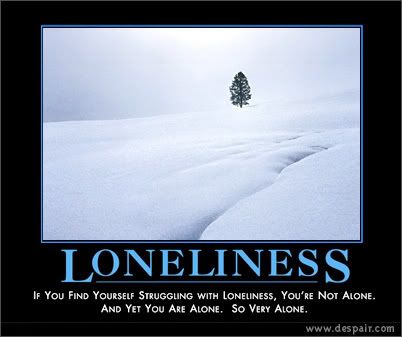
Earlier in the week I woke up before the sun to send two friends off at Logan airport. On the solo drive home it occurred to me, as it has so many times before, that loneliness, though saddening or irritating at times, begs you to know yourself. I hold it dear.
 It looked like dusk as the sun rose in an overcast sky. NPR news was quiet on the radio. At first everything I passed gave the impression of turning inward - the run-down commercial lots unopened at that hour of the morning, the streetlights shutting off - but I realized that that was just how I felt. It's the middle of my 24th New England winter, a season when introspection comes naturally. But knowing what comes next, I also feel optimistic.
Soon the pavement will be washed of salt and turn black again, with a few more potholes to show for its trials. Soon the harbor down the street from my house will fill with boats, and people will shed their knitted goods like reptiles shed dead skin. Last night I dreamed I was planting seedlings in a garden. Spring is already happening in my mind, though it is still a couple months away.
I felt it viscerally on the drive home: isolation, exhaustion, and hope. A poignant emotional sensation seemingly spawned from thin air.
To get back to my point about loneliness: the frustrating thing about being human, and a writer especially, is that no matter how many words I use I'll never be able to convey the whole truth of that morning drive home. You will still only have a snapshot of my experience, because you can't possibly know all the things that led up to it. A whole lifetime has gone into crafting this complex filter of associations, where each new stimulus inspires a recollection of things already felt. We are fundamentally alone in the way we experience the world. No one else can see through our eyes.
In the novel Gilead by Marilyn Robinson, the protagonist (an old preacher in rural Iowa) expresses this sentiment very eloquently:
"In every important way we are such secrets from each other, and I do believe there is a separate language in each of us, also a separate aesthetics and a separate jurisprudence. Every single one of us is a little civilization built on the ruins of any number of preceding civilizations, but with our own variant notions of what is beautiful and what is acceptable - which, I hasten to add, we generally do not satisfy and by which we struggle to live. We take fortuitous resemblances among us to be actual likeness, because those around us have also fallen heir to the same customs, trade in the same coin, acknowledge, more or less, the same notions of decency and sanity. But all that really just allows us to coexist with the inviolable, untraversable, and utterly vast spaces between us."
I think learning to value our inherent solitude is essential, because if the self is the only person we can ever really know - and even that is a huge task - then we must learn to pay close attention to the weather inside. I try to find time every day to be alone, to poke amongst the ruins of my private civilization and see how they serve as a springboard for the way I carry myself in the world.
More on this theme next time...
 It looked like dusk as the sun rose in an overcast sky. NPR news was quiet on the radio. At first everything I passed gave the impression of turning inward - the run-down commercial lots unopened at that hour of the morning, the streetlights shutting off - but I realized that that was just how I felt. It's the middle of my 24th New England winter, a season when introspection comes naturally. But knowing what comes next, I also feel optimistic.
Soon the pavement will be washed of salt and turn black again, with a few more potholes to show for its trials. Soon the harbor down the street from my house will fill with boats, and people will shed their knitted goods like reptiles shed dead skin. Last night I dreamed I was planting seedlings in a garden. Spring is already happening in my mind, though it is still a couple months away.
I felt it viscerally on the drive home: isolation, exhaustion, and hope. A poignant emotional sensation seemingly spawned from thin air.
To get back to my point about loneliness: the frustrating thing about being human, and a writer especially, is that no matter how many words I use I'll never be able to convey the whole truth of that morning drive home. You will still only have a snapshot of my experience, because you can't possibly know all the things that led up to it. A whole lifetime has gone into crafting this complex filter of associations, where each new stimulus inspires a recollection of things already felt. We are fundamentally alone in the way we experience the world. No one else can see through our eyes.
In the novel Gilead by Marilyn Robinson, the protagonist (an old preacher in rural Iowa) expresses this sentiment very eloquently:
"In every important way we are such secrets from each other, and I do believe there is a separate language in each of us, also a separate aesthetics and a separate jurisprudence. Every single one of us is a little civilization built on the ruins of any number of preceding civilizations, but with our own variant notions of what is beautiful and what is acceptable - which, I hasten to add, we generally do not satisfy and by which we struggle to live. We take fortuitous resemblances among us to be actual likeness, because those around us have also fallen heir to the same customs, trade in the same coin, acknowledge, more or less, the same notions of decency and sanity. But all that really just allows us to coexist with the inviolable, untraversable, and utterly vast spaces between us."
I think learning to value our inherent solitude is essential, because if the self is the only person we can ever really know - and even that is a huge task - then we must learn to pay close attention to the weather inside. I try to find time every day to be alone, to poke amongst the ruins of my private civilization and see how they serve as a springboard for the way I carry myself in the world.
More on this theme next time...
Feb 14, 2010
If I could give the world a mix tape
Here is a playlist I hope will make you feel good.
Happy Valentine's Day!
Happy Valentine's Day!
Jan 27, 2010
On Being an OM-nivore
I read this article in the Times today about the role of food in the American yoga community. The debate about vegetarianism is ongoing – can you really live on the yogic path if you eat meat? One of the first moral principles listed by Patanjali in his Yoga Sutras (one of the foundational texts of yoga, dating back about 2000 years) is that of ahimsa, or non-violence. It means not causing harm to other sentient beings.
It’s unfortunate that the condition of the meat industry is such that we can’t eat meat with a clearer conscience. The result of our meat consumption is violence done not only to the animals, but also the environment, the laborers, and our own bodies. It is no wonder, then, that some avid meat-eaters feel a need to defend their decisions with an attitude of “I don’t give a shit, vegetarians are pussies.”
That said, I love bacon. And cheeseburgers. And cheeseburgers with bacon. These are temptations that my body doesn’t need the same way it needs leafy greens, though, so I only eat them every now and then. That’s my decision. A monthly cheeseburger tastes better than a weekly cheeseburger, anyways.
I wholeheartedly encourage anyone who wants to take up a meat-free diet. It does make a difference. For the rest of us, I’m going to make my usual argument: If we make choices mindfully, staying open to the truth of our actions, this awareness will contribute not only to our own well-being, but to the well-being of the world at large.
You eat to fuel yourself, but what are you fueling yourself towards? Everyday you take nourishment, likely shipped from far-away places for your consumption. Chances are there was some suffering involved in the process of providing you this food. What do you give in return?
At Thich Naht Hahn’s monastery in France, they recite the following Five Contemplations before every meal. Although this particular mindfulness practice stems from a Zen tradition, it is not unlike the Christian tradition of “saying grace.” I’ve posted them on the wall beside my kitchen table as a daily reminder that the ability to eat – no matter what we are eating - is not as simple or mundane as we might take for granted.
This food is a gift from the whole universe – the earth, the sky, and much hard work.
May we live in a way that is worthy of this food.
May we transform our unskillful states of mind, especially that of greed.
May we eat only foods that nourish us and prevent illness.
May we accept this food for the realization of the way of understanding and love.
Bon appetit!
It’s unfortunate that the condition of the meat industry is such that we can’t eat meat with a clearer conscience. The result of our meat consumption is violence done not only to the animals, but also the environment, the laborers, and our own bodies. It is no wonder, then, that some avid meat-eaters feel a need to defend their decisions with an attitude of “I don’t give a shit, vegetarians are pussies.”
That said, I love bacon. And cheeseburgers. And cheeseburgers with bacon. These are temptations that my body doesn’t need the same way it needs leafy greens, though, so I only eat them every now and then. That’s my decision. A monthly cheeseburger tastes better than a weekly cheeseburger, anyways.
I wholeheartedly encourage anyone who wants to take up a meat-free diet. It does make a difference. For the rest of us, I’m going to make my usual argument: If we make choices mindfully, staying open to the truth of our actions, this awareness will contribute not only to our own well-being, but to the well-being of the world at large.
You eat to fuel yourself, but what are you fueling yourself towards? Everyday you take nourishment, likely shipped from far-away places for your consumption. Chances are there was some suffering involved in the process of providing you this food. What do you give in return?
At Thich Naht Hahn’s monastery in France, they recite the following Five Contemplations before every meal. Although this particular mindfulness practice stems from a Zen tradition, it is not unlike the Christian tradition of “saying grace.” I’ve posted them on the wall beside my kitchen table as a daily reminder that the ability to eat – no matter what we are eating - is not as simple or mundane as we might take for granted.
This food is a gift from the whole universe – the earth, the sky, and much hard work.
May we live in a way that is worthy of this food.
May we transform our unskillful states of mind, especially that of greed.
May we eat only foods that nourish us and prevent illness.
May we accept this food for the realization of the way of understanding and love.
Bon appetit!
Jan 22, 2010
Yoga as a Creative Act
Being creative is absolutely necessary to being well. It's in our nature to create. We have the opportunity to make something from whatever comes our way - whether it be music from an instrument, a meal from wholesome ingredients, or peace from chaos.
Sometimes I get caught up in my to-do list. I don't trust my inner child to be responsible, so I don't let her out. Who has time to cook when the sink is already full of dishes? Who has time to write a letter to an old friend when the bills need to be paid? But finding how to cope with the stresses of adult life, balancing what you want to do with what you need to do, is a creative process in itself.
I see yoga as a central creative act, a jumping-off place for all other endeavors, because a spacious quality of mind comes with regular practice. My thoughts refocus, setting all worrisome distractions aside in order to arrive in the present moment. To-do lists dissolve in the face of a challenging balance like Half Moon pose, because you generally can't balance on one foot with your limbs reaching in all directions and let your brain chatter away at the same time. Yoga cultivates control of the mind.
When you can focus your attention on the wisdom of the body, the physical sensations of the asanas (poses) become a joy to explore. I'm made aware of my aliveness. As I expand my body with breath, which is also called prana (life-energy), I create length, alignment, strength, and balance - a sound physical foundation to work from in all the other aspects of my life.
In this joyful, silent space where the mind is stilled and the body is nourished, creative solutions arise organically. It is a time to pause, go inward, and see where you are at.
Sometimes I get caught up in my to-do list. I don't trust my inner child to be responsible, so I don't let her out. Who has time to cook when the sink is already full of dishes? Who has time to write a letter to an old friend when the bills need to be paid? But finding how to cope with the stresses of adult life, balancing what you want to do with what you need to do, is a creative process in itself.
I see yoga as a central creative act, a jumping-off place for all other endeavors, because a spacious quality of mind comes with regular practice. My thoughts refocus, setting all worrisome distractions aside in order to arrive in the present moment. To-do lists dissolve in the face of a challenging balance like Half Moon pose, because you generally can't balance on one foot with your limbs reaching in all directions and let your brain chatter away at the same time. Yoga cultivates control of the mind.
When you can focus your attention on the wisdom of the body, the physical sensations of the asanas (poses) become a joy to explore. I'm made aware of my aliveness. As I expand my body with breath, which is also called prana (life-energy), I create length, alignment, strength, and balance - a sound physical foundation to work from in all the other aspects of my life.
In this joyful, silent space where the mind is stilled and the body is nourished, creative solutions arise organically. It is a time to pause, go inward, and see where you are at.
Jan 19, 2010
Support Your Fish, Open Your Heart
In my practice (life + attention), I've found that the heart is more than an organ pumping blood. It is an energetic storehouse for personal truths.
It amazes me how vividly the mind manifests in that mushy spot beneath the sternum. When the mind is excited, the heart races. When the mind is at peace, the heart feels warm and expansive. When the mind experiences a sense of loss, the term "heartache" becomes irritatingly true to form.
If we tune into what's going on in our bodies, we often get clues about the things in our life that need to be addressed. It behooves us to pay closer attention to the heart, this poignant center of the mind-body connection.
Lately I've discovered that I hunch my shoulders forward in times of emotional upheaval, as though to protect my heart by literally closing my body around it. This creates a lot of tension in the upper back and chest. Some people live with this kind of tension for years, hunching their shoulders to subconsciously delay the healing process. I urge you to be compassionate with yourself, and try the following pose to keep your heart open.
This is a supported version of Matsyasana or Fish Pose. It opens the chest and releases tension in the upper back. This pose can be used for emotional healing, or just to correct bad posture (though I would argue that the two are usually related).
Position a support of some kind under your back, below your heart.
 Whatever variation of this pose suits you, breathe deeply. With each inhalation, imagine your heart opens wide. On the exhale, fully let go. As your chest opens, your back melts over the support. Stay with this - breathing, opening, and relaxing - for at least five minutes. Sometimes I do it for 20. In my experience with this pose, the more tension you release, the more you will see where you are still holding on.
At the end of this practice, carefully remove the support from under you and hug your knees to your chest. If it is comfortable, bring your head to your knees to round out your back.
If you want to share your experiences with this pose or if you have any questions, feel free to leave a comment or email me at jadetweston (at) gmail (dot) com. I honor your intention to do something kind for yourself.
Namaste.
It amazes me how vividly the mind manifests in that mushy spot beneath the sternum. When the mind is excited, the heart races. When the mind is at peace, the heart feels warm and expansive. When the mind experiences a sense of loss, the term "heartache" becomes irritatingly true to form.
If we tune into what's going on in our bodies, we often get clues about the things in our life that need to be addressed. It behooves us to pay closer attention to the heart, this poignant center of the mind-body connection.
Lately I've discovered that I hunch my shoulders forward in times of emotional upheaval, as though to protect my heart by literally closing my body around it. This creates a lot of tension in the upper back and chest. Some people live with this kind of tension for years, hunching their shoulders to subconsciously delay the healing process. I urge you to be compassionate with yourself, and try the following pose to keep your heart open.
This is a supported version of Matsyasana or Fish Pose. It opens the chest and releases tension in the upper back. This pose can be used for emotional healing, or just to correct bad posture (though I would argue that the two are usually related).
Position a support of some kind under your back, below your heart.
If you are pretty new to this kind of thing (like my friend Paul, pictured below) use a rolled blanket. Another folded blanket or cushion under your head is recommended to prevent compression in the back of the neck. Keep your knees bent to support your lower back.
If you are a little more advanced in a yoga practice, try using a rolled mat (as I am pictured) or a block. If you are a regular practitioner, you may not need a support under your head to keep the back of your neck long, and you may also be able to lengthen your legs away from you without putting strain on your lower back. Just do what is comfortable.
 Whatever variation of this pose suits you, breathe deeply. With each inhalation, imagine your heart opens wide. On the exhale, fully let go. As your chest opens, your back melts over the support. Stay with this - breathing, opening, and relaxing - for at least five minutes. Sometimes I do it for 20. In my experience with this pose, the more tension you release, the more you will see where you are still holding on.
At the end of this practice, carefully remove the support from under you and hug your knees to your chest. If it is comfortable, bring your head to your knees to round out your back.
If you want to share your experiences with this pose or if you have any questions, feel free to leave a comment or email me at jadetweston (at) gmail (dot) com. I honor your intention to do something kind for yourself.
Namaste.
Jan 11, 2010
Breathing down the mountain
I went skiing for the second time in my life on New Year's Day.
Warmest thanks to my friend Colin, who has skied for almost as long as he's walked. Colin continually pushes me to try things that are new and challenging, and then maintains an almost inhuman level of patience while I cop a bad attitude about it. At the end of our adventures together - usually while I tend my wounds (road rash, aches and bruises, near-hypothermia, damaged ego) - I realize how much I'm actually capable of enduring. We should all be so lucky to have friends that make us meet our edges. I try not to sound sarcastic while extending this gratitude, though it is sometimes difficult.
Putting me on skis was Colin's idea. First I was excited to go. Then I saw the mountain and got nervous. Then I fell down the mountain and got frustrated. But by the end of the day I was genuinely enjoying myself.

Being bad at skiing taught me a few lessons.
Firstly, my lack of patience (which usually reveals itself when I'm doing something that I am not particularly good at) is laughably unhelpful. At the beginning of the day I actually accused Colin of not having any patience for me, but he politely pointed out that I was projecting. Then I noticed it again and again; when I felt I was about to fall, my mind would suddenly flood with self-damning babble: I should be better at this, that four-year-old on a leash is better at this, why is this mountain so big, why is no one else falling down, I'm probably going to break both my legs, I should have worn a helmet.
The good thing about practicing yoga and meditation almost daily is that I picked up on these thought patterns pretty quickly. I saw them, and allowed them to happen while I pulled my attention to more important matters: namely, my movement and balance.
Think of this shift of attention as being similar to the way a loving parent ignores her child's temper tantrum. The wisdom-mind, which is grounded in the breath and the body, is the loving parent. The ego, which flails around on the vehicle of your thoughts, is the irritating child. Don't hit the child, just let it do its thing. If we approach our thoughts with this attitude of acceptance, without indulging or repressing them, they settle on their own.
I got better at skiing when I remembered to breathe. When you practice yoga, the movement of the breath accompanies the movement of the body. As I cruised down the mountain at a faster and faster pace, I tried to align my breath with my movement, beginning each inhale and exhale with each turn of my hips. When I could do this, my mind was quiet and the motion came naturally. I felt a little more graceful. If I thought about how I felt graceful, my skis would cross and I would tumble forward like a drunken Superman.
That was a big one to take off the mountain: I saw clearly that the mind's natural tendency is to detract from your experience of the present moment by cluttering it with thoughts. I knew this already, but trying to ski made it slapstick comedy.
If you can come back to the breath again and again, you will see how your monkey-mind starts to take the back burner. In its absence, your awareness is heightened and your sensory experience becomes more vivid. Activity is experienced in a way that is whole and visceral, as if each action were complete in itself.
Whether you are skiing, doing dishes, paying the bills, or driving, coming back to the breath is like being born back into reality. Sometimes we only catch glimpses of the world around us before the chatter picks up and we fall on our asses again. But from what I've seen in those instances of clarity, each moment is new.
Warmest thanks to my friend Colin, who has skied for almost as long as he's walked. Colin continually pushes me to try things that are new and challenging, and then maintains an almost inhuman level of patience while I cop a bad attitude about it. At the end of our adventures together - usually while I tend my wounds (road rash, aches and bruises, near-hypothermia, damaged ego) - I realize how much I'm actually capable of enduring. We should all be so lucky to have friends that make us meet our edges. I try not to sound sarcastic while extending this gratitude, though it is sometimes difficult.
Putting me on skis was Colin's idea. First I was excited to go. Then I saw the mountain and got nervous. Then I fell down the mountain and got frustrated. But by the end of the day I was genuinely enjoying myself.

Being bad at skiing taught me a few lessons.
Firstly, my lack of patience (which usually reveals itself when I'm doing something that I am not particularly good at) is laughably unhelpful. At the beginning of the day I actually accused Colin of not having any patience for me, but he politely pointed out that I was projecting. Then I noticed it again and again; when I felt I was about to fall, my mind would suddenly flood with self-damning babble: I should be better at this, that four-year-old on a leash is better at this, why is this mountain so big, why is no one else falling down, I'm probably going to break both my legs, I should have worn a helmet.
The good thing about practicing yoga and meditation almost daily is that I picked up on these thought patterns pretty quickly. I saw them, and allowed them to happen while I pulled my attention to more important matters: namely, my movement and balance.
Think of this shift of attention as being similar to the way a loving parent ignores her child's temper tantrum. The wisdom-mind, which is grounded in the breath and the body, is the loving parent. The ego, which flails around on the vehicle of your thoughts, is the irritating child. Don't hit the child, just let it do its thing. If we approach our thoughts with this attitude of acceptance, without indulging or repressing them, they settle on their own.
I got better at skiing when I remembered to breathe. When you practice yoga, the movement of the breath accompanies the movement of the body. As I cruised down the mountain at a faster and faster pace, I tried to align my breath with my movement, beginning each inhale and exhale with each turn of my hips. When I could do this, my mind was quiet and the motion came naturally. I felt a little more graceful. If I thought about how I felt graceful, my skis would cross and I would tumble forward like a drunken Superman.
That was a big one to take off the mountain: I saw clearly that the mind's natural tendency is to detract from your experience of the present moment by cluttering it with thoughts. I knew this already, but trying to ski made it slapstick comedy.
If you can come back to the breath again and again, you will see how your monkey-mind starts to take the back burner. In its absence, your awareness is heightened and your sensory experience becomes more vivid. Activity is experienced in a way that is whole and visceral, as if each action were complete in itself.
Whether you are skiing, doing dishes, paying the bills, or driving, coming back to the breath is like being born back into reality. Sometimes we only catch glimpses of the world around us before the chatter picks up and we fall on our asses again. But from what I've seen in those instances of clarity, each moment is new.
Subscribe to:
Posts (Atom)


 Posts
Posts